Luca Sala

Scientist at Istituto Auxologico Italiano IRCCS
Cardiac arrhythmias | Drug discovery | Precision medicine | Human iPSC models | In ❤️ with data

prof_pic.jpg

I am a scientist at the Laboratory of Cardiovascular Genetics, Istituto Auxologico Italiano IRCCS, within the Center for Cardiac Arrhythmias of Genetic Origin directed by Prof. Peter J. Schwartz.

My work is focused on the study of congenital and acquired cardiac arrhythmias with human and patient-specific in vitro models based on human induced pluripotent stem cells.

I aim to understand the complexity of genotype-phenotype relationships for congenital and acquired cardiac arrhythmias and to use in vitro data to provide relevant information to clinicians for patient risk-stratification and precision medicine, harnessing the power of machine learning and automation on biological data.

To ultimately reduce the need for animals in pharmacological and toxicological research, I aim to optimise current drug screening platforms by using patient-specific human-based models and advanced hardware and software tools.

In my free time, I like to code 👨🏻‍💻, ride my mountain bike 🚵🏻‍♂️ and run 🏃🏻.

Research areas

🧬
Disease Modelling

Patient-specific hiPSC-derived cardiomyocytes to study genotype-phenotype relationships in Long QT Syndrome and calmodulinopathies.

⚡️
Electrophysiology & Technology

Single-cell and multicellular recordings, contraction analysis, and machine learning for patient risk stratification.

💊
Drug Screening & Precision Medicine

Human-based platforms for cardiotoxicity assessment, drug repurposing, safety pharmacology, and new approach methodologies (NAMs) to reduce animal testing.
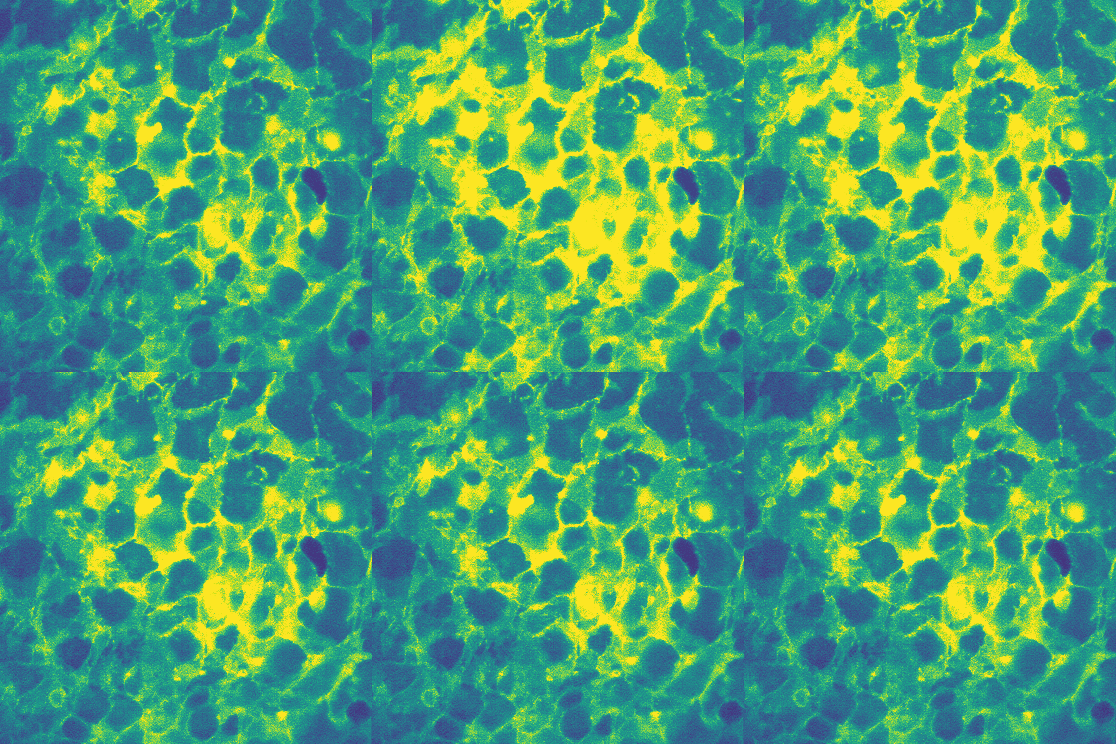
The beauty of voltage imaging in hiPSC-derived cardiomyocytes

news

selected publications

  1. Non-invasive action potential recordings using printed electrolyte-gated polymer field-effect transistors
    Adrica Kyndiah, Giulia Zoe Zemignani, Carlotta Ronchi, Gabriele Tullii, Aleksandr Khudiakov, Giuseppina Iachetta, Stefano Chiodini, Rosalia Moreddu, Fabrizio Antonio Viola, Peter J. Schwartz, Gabriel Gomila, Francesco De Angelis, Luca Sala#, Maria Rosa Antognazza, and Mario Caironi
    Nature Communications, 2025
  2. Multiplexed assays of variant effect and automated patch clamping improve KCNH2-LQTS variant classification and cardiac event risk stratification
    Matthew J O’Neill, Chai-Ann Ng, Takanori Aizawa, Luca Sala, Sahej Bains, Annika Winbo, Rizwan Ullah, Qianyi Shen, Chek-Ying Tan, Krystian Kozek, and  others
    Circulation, 2024
  3. MUSCLEMOTION: a versatile open software tool to quantify cardiomyocyte and cardiac muscle contraction in vitro and in vivo
    Luca Sala*, Berend J Van Meer, Leon GJ Tertoolen, Jeroen Bakkers, Milena Bellin, Richard P Davis, Chris Denning, Michel AE Dieben, Thomas Eschenhagen, Elisa Giacomelli, and  others
    Circulation research, 2018
  4. BJP
    Integrating cardiomyocytes from human pluripotent stem cells in safety pharmacology: has the time come?
    Luca Sala, Milena Bellin, and Christine L Mummery
    British journal of pharmacology, 2017
  5. A new hERG allosteric modulator rescues genetic and drug-induced long-QT syndrome phenotypes in cardiomyocytes from isogenic pairs of patient induced pluripotent stem cells
    Luca Sala, Zhiyi Yu, Dorien Ward-van Oostwaard, Jacobus PD Veldhoven, Alessandra Moretti, Karl-Ludwig Laugwitz, Christine L Mummery, Adriaan P IJzerman, and Milena Bellin
    EMBO molecular medicine, 2016